Ashmeen Modikhan claims she’s the victim of a “mortgage scam” that wrongfully sucked tens of thousands of dollars from her workers’ compensation award money. With the help of a paralegal in Florida and a retired lawyer in California, she was able to get most but not all of the money back, she says. She says the mortgage scam continues and that now the target is potential proceeds from a personal injury lawsuit she filed seven years ago.
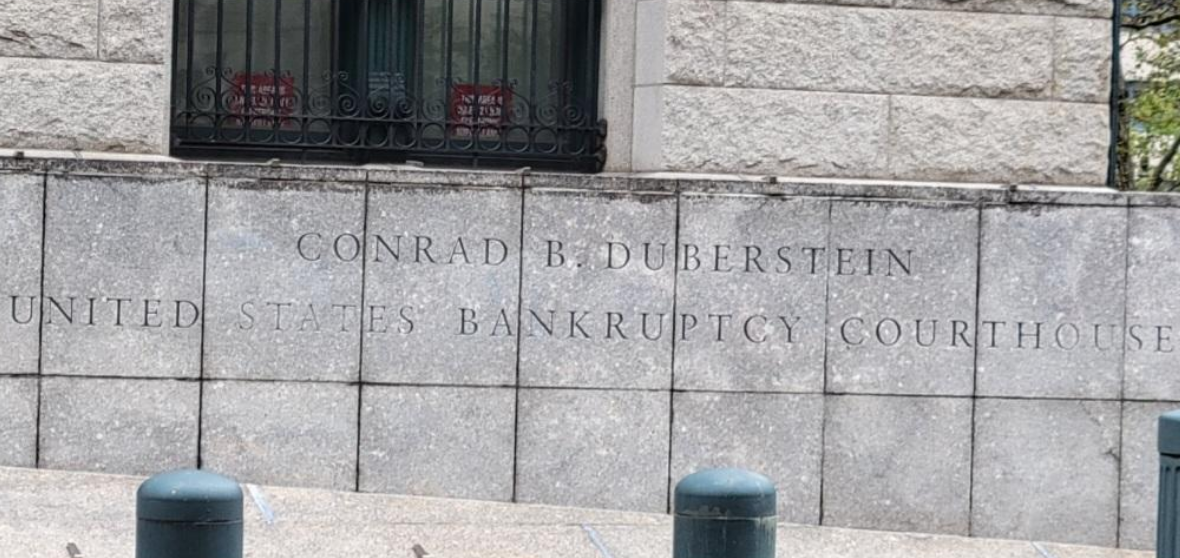
She alleges that her own lawyers—the one on her personal injury case and another who was supposed to help her in bankruptcy court—have “betrayed” her. What’s more, claims Modikhan, the alleged scam operates within the federal bankruptcy court, in the Eastern District of New York, where she had sought protection from what she says were “Illegal wrongful foreclosures” on her three properties. The Florida property was “illegally” foreclosed on in 2009 and two New York properties, in 2010 and 2012.
Modikhan claims the alleged mortgage scam is given the cover of legitimacy because it’s being conducted during bankruptcy proceedings in the Eastern District Court right in front of the judges. She says she succeeded in having the first judge who handled her case, Elizabeth S. Stong, removed after she complained in writing to Chief Judge Alan S. Trust.
When the Black Star News contacted Judge Trust for comment about Modikhan’s claims that she’s been a victim of an alleged mortgage scam in the court, spokesperson Yvette Mills says in an e-mail message: “Chief Judge Trust does not comment on matters before him.”
Modikhan claims the current judge, Jill Mazer-Marino, has allowed the parties arrayed against her to file “fraudulent” proofs of claim, using “forged” notes that don’t bear original signatures in addition to “false” motions. Modikhan says her path to bankruptcy began after the 2008 great recession, just as it did for millions of other Americans. The properties went underwater and her main source of income was no more.
Modikhan was working as a customer care representative for American Airlines; she also had a job at a travel agency, which she lost. With her remaining one income, Modikhan struggled to make payments on her three properties. With the advice of a lawyer, Modikhan filed for bankruptcy protection through a lawyer named Craig D. Robins in 2012 and the lawyer told her that her debts had been discharged. “That’s what the dockets in the bankruptcy court in the eastern district also shows,” Modikhan says. Robins didn’t return an e-mail message seeking comment.
Yet, a few years later, in 2014 Modikhan started getting letters from several debt collection companies, including Rushmore Loan Management Services LLC, claiming that they were the loan servicers for creditors on her properties. “These are all debt collectors. The are not the real parties of interest—they all pretend to be lenders,” she says.
Modikhan hired Aronow Law to represent her, in November 2019, and paid the firm $3,500 as retainer. At the time of signing the retainer agreement she informed the law firm that she had filed a personal injury case against a company called Golden Touch Transportation LLC, as a result of an injury she’s suffered while working at American Airlines, and about her workers compensation settlements.
However, she became suspicious when the paralegal at Aronow, Kathryn Venezia told her that before the loan modification was processed—it would be on a trial basis for nine months—Modikhan would have to make monthly payments amounting to tens of thousands of dollars to Aronow Law, Rushmore Loan Management Services, and to Marianne De Rosa, the Chapter 13 Trustee in bankruptcy court.
Modikhan paid Aronow $1,000 per month for the loan modification on each property and De Rosa, the trustee, received $4,800 each month. Modikhan said Hanin R. Shadood, an attorney with the Aronow firm instructed her to set up an electronic system so that her payments could be automatically withdrawn from her checking account. “They all knew this money was coming from my worker’s compensation payment, which is supposed to be exempt,” she says.
“I kept asking why I was making such huge payments if the loan modification was not yet in place,” Modikhan says. “I got e-mails sent from Jessica Mazur, a paralegal from Aronow Law, saying if I didn’t make the payments that my case would be dismissed.”
Modikhan claims that to cover up their alleged deception, when the lawyer whom she worked with at Aronow Law, Shadood, submitted documents to the court called a schedule for the loan modification in December 2019, she claimed that she had $63,000 in her checking account when in fact she only had $1,706. Modikhan wasn’t aware that the firm had done this until much later. Shadood e-signed the schedule with Modikhan’s name and never even showed it to her, she says.
She said Shadood also asked her to provide her three adult working children’s pay stubs and bank statements. “I thought this was very strange since my children had nothing to do with my properties,” she says. She also found out later that Aronow had not disclosed in the documents the fact that she’d filed a personal injury lawsuit.
During a hearing before then trustee De Rosa on March 4, 2020, the trustee told Modikhan that Shadood was now working for her. “This was very confusing,” Modikhan says. “So while working for De Rosa she also remained my attorney on the record until February 3, 2021.” During the March 4, 2020 hearing the trustee discussed Modikhan’s personal injury lawsuit. Modikhan says the court transcripts deleted the section from the March 4, 2020 hearing where De Rosa says Shadood was now working for her.
Modikhan paid Aronow $1,000 per month and the trustee De Rosa $4,800 per month from December 2019. Then, in August 2020, Aronow instructed Modikhan to start making $2,950 monthly payments to Rushmore for loan modification that the law firm said had been approved for one of her two remaining New York properties—she’d been forced into a short sale of the Florida property. She was told that loan modification for a second property had not yet been approved and that it was being done outside the bankruptcy court.
This means when all the payments were added up—$2,950 to Rushmore, $1,000 to Aronow, and $4,800 to De Rosa—She was shelling out $8,750 a month. Over a period of 13 months, from November 2019 to December 2020, Modikhan says she paid out a total of $90,537 to Aronow, De Rosa, and Rushmore—with the latter’s payments starting in August 2020.
“I was being financially raped,” she says. Modikhan was desperate. On the internet, she read stories about unsuspecting homeowners who’d lost hundreds of thousands of dollars and their properties in mortgage scams. She watched YouTube videos teaching homeowners how to fight back. She joined several groups of homeowners who’d been victimized in mortgage scams and who held weekly meetings via zoom.
On Dec. 30, 2020, the founder of one of the groups, a retired lawyer named Ron O’Donnell, who’s based in California, and educates homeowners, confronted Darren Aronow, in a phone call. “He told Aronow that ‘what you’re doing to this lady is wrong,’” Modikhan says. On that same day, Aronow filed papers to be relieved as Modikhan’s lawyer. “The plaintiff disagreed on the direction of the bankruptcy case. The plaintiff believed Law PC was conspiring with Rushmore, and the plaintiff would no longer communicate with counsel,” Aronow wrote; this was to make it appear as if she was the problem, Modikhan says.
The retired lawyer O’Donnell, in one of his weekly sessions, spoke of the importance of accounting which led Modikhan to write letters to demand refund of all her monies, and an accounting, from Aronow, De Rosa, and Rushmore.
Modikhan says Aronow refunded $13,065 on Feb. 25, 2021; and, De Rosa, returned $61,680, on March 19, 2021. “I’m still owed $1,405 from Darren Aronow and $5,520 from Marianne De Rosa,” Modikhan says. “Rushmore refused to refund $8,867.26 in payments I made.” Darren Aronow of Aronow Law didn’t respond to an e-mail message from Black Star News seeking comment for this article. Rushmore also didn’t respond to a message seeking comment.
Modikhan filed a motion for Judge Stong to recuse herself from the case, twice. It was only after she wrote to Chief Judge Trust that Stong recused herself, she says. Judge Jill Mazer-Marino was assigned to preside over the case.
“You’d think that now that I’d caught the opposing parities deceiving me into making wrongful payments, the first thing Judge Mazer-Marino would do was make sure I got a proper investigation on all involved. Things became worse,” Modikhan says. Modikhan initiated an “adversarial action,” in essence she sued Darren Aronow, De Rosa, and Courtney R. Williams, a lawyer from Gross Polowy LLC, who represents several entities including Rushmore. She claimed they’d steered her into a “mortgage scam” and deceived her into making the payments from her exempted workers compensation funds.
However, Judge Mazer-Marino granted the opposing parties’ motions to dismiss the case against them, with prejudice. [Except for partial malpractice against Aronow]. “They were caught in the act. Instead of supporting sanctions against the parties who wronged me, Judge Mazer-Marino wants them to just walk away,” Modikhan says. “Where is the rest of my money from my exempted funds? Where is the accounting?”
Modikhan questions how the judge, who is also presiding over her bankruptcy case, could be impartial on the adversarial action. “This looked like a conflict of interest to me. I was denied my day in court,” she says. Modikhan has filed a motion for Judge Mazer-Marino to reconsider her decision dismissing the case; the judge has scheduled a hearing on the motion for Aug. 2.
Modikhan contacted the Queens County District Attorney’s office to complain about the alleged mortgage scam. She provided the District Attorney a copy of comprehensive report detailing how she’d been victimized, prepared by Paris F. Dube, a Florida based paralegal and owner of Paris’ Outsource Paralegal Services. Ms. Dube has a reputation for helping victims expose mortgage scams. She met with three prosecutors after she’d corresponded with Michael Albanese, an assistant district attorney.
“Upon a thorough review of Ms. Ashmeen Modikhan’s grievances, our office determined that this matter falls outside of our jurisdiction,” a spokesperson responded via e-mail message when Black Star News reached out to Albanese.
Ms. Modikhan says the Queens County District Attorney dropped the ball by ignoring the report by Ms. Dube. The injury Modikhan suffered occurred in 2014 while she was on the job. She was about to exit a bus that ferried American Airlines employees between terminals and employees’ parking lots when her right hand was crushed when the door shut on it.
Modikhan hired a lawyer named Frank Cassisi, in Mineola, New York, to represent her in a lawsuit against the bus company, Golden Touch Transportation LLC. She says the demand filed in court is $5 million, as indicated in the court docket, and she only knew of this during this bankruptcy process. She said the injury left her in constant severe pain. She barely has motion on the right hand and sometimes it turns blue, depending on the weather conditions. Modikhan is a brown-skinned immigrant from Trinidad.
Modikhan says she’d asked Cassisi to provide her, in writing, a status update about her case, with no success. Frustrated with what she perceives as bias against her in the bankruptcy court, on March 14, 2022, Modikhan filed a motion to withdraw from the bankruptcy proceedings.
She says on March 15, 2022, right after her hearing, Cassisi, the lawyer, called her and informed her that Tracy Heston, who is the current trustee Alan Nisselson’s assistant, contacted him and told him the trustee was “concerned” with her action, referring to the motion. She says Cassisi also told her that she was no longer his client; that the trustee Nisselson was the new client. “This is exactly what happened to Shadood, my lawyer with Aronow,” Modikhan says. Cassisi also told her that he and the trustee believed taking her personal injury case to trial was risky because she was too “emotionally” fragile and a jury could react negatively.
“This was the first time I see anything in writing about this alleged settlement,” Modikhan says. “How can a lawsuit where I’m the victim be settled without my knowledge, involvement, or approval? Where is the copy of the settlement agreement? How do I even know this letter from Skura is authentic?”
Skura, an attorney with Lewis Brisbois Bisgaard & Smith, who represents Golden Touch, didn’t respond to an e-mail message from Black Star News seeking comment.
Modikhan wrote a letter to Cassisi informing him that she rejected the purported settlement and that she wanted to go to trial. She copied Chief Judge Trust in the bankruptcy court, Judge Mazer-Marino, the New York Attorney General Letitia James, Assistant District Attorney Albanese, the U.S. Attorney for the Eastern District, and other parties.
“I live in pain from my horrific accident every day. I have limited use of my right hand and have to depend on my left hand and others for assistance. My hand turns blue and the pain is extreme,” Modikhan said, in her letter to Cassisi dated June 28, 2022. “I came to you seeking help so that Golden Touch Transportation could do the right thing. I will not stand by and be betrayed into life long poverty.”
She also wrote to the administrative Judge in New York State Supreme Court in Queens County, Marguerite A. Grays, asking for time to dismiss Cassisi and hire a new lawyer; she copied the letter to the Grievance Committee. After she wrote the letters, suddenly there was a flurry of activity on the court docket related to her personal injury case. There’s now a pre-trial court date slated for October 5, 2022.
Meanwhile the court has set three court dates. In addition to the Aug. 2 hearing on Modikhan’s motion for reconsideration, Mazer-Marino will hear her motion to withdraw from the bankruptcy proceedings on Aug. 9, 2022.
Judge Mazer-Marino has also set Aug. 25, 2022 as the date to hear the trustee’s motion to approve the purported $500,000 settlement, even though Modikhan has informed the State Supreme Court in Queens county that she’s dismissing Cassisi and hiring a new lawyer, and the court has set a trial date of Oct. 5, 2022 for her personal injury case.
This story will continue in parts two and three. Part two will focus on what Modikhan claims were “fraudulent” notes and “false” motions that the judges have allowed to be entered into the court.